
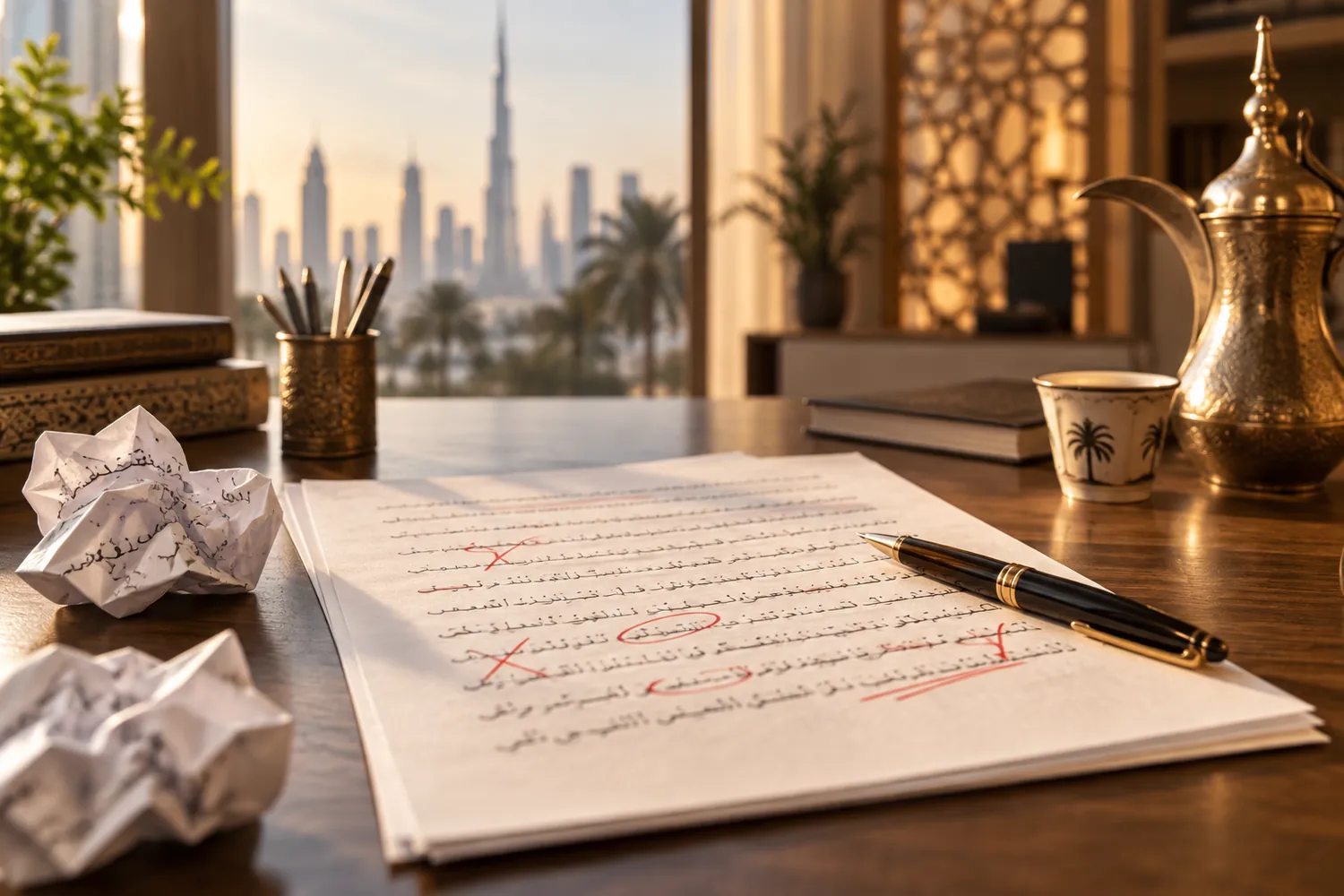
Ask a generation tool for a paragraph in Arabic and it produces something grammatically fluent within seconds. That fluency is exactly what makes the output risky to publish unedited — it reads correctly to anyone who does not already know the audience, which is precisely the group least able to catch what is wrong with it.
Modern Standard Arabic is not what most customers speak
Generated Arabic defaults to a formal, newsreader-style register — Modern Standard Arabic, close to what appears in official documents and news broadcasts. That register is genuinely appropriate for a contract or a formal notice. It is the wrong register for a social caption, a WhatsApp message, or an ad aimed at a UAE audience, where the everyday mix leans toward Gulf dialect and a more conversational tone. Content that never leaves MSA behind reads as stiff and slightly foreign to the people it is meant to reach, even though every sentence is technically correct.
Register can slip inside a single paragraph
A generated passage sometimes opens in a formal register and drifts into a more casual sign-off, or reaches for a word that is standard in Egyptian or Levantine Arabic but sounds odd to a Gulf reader. None of this shows up as an error to a grammar check — it shows up as a text that a native reader senses is slightly off without always being able to say why. Catching this requires someone who reads the piece the way the intended audience would, not someone checking only that the sentences parse.
Terminology and transliteration drift across a document
Brand names, product features and English loanwords get transliterated inconsistently — one section spells a term one way, another section spells it differently, and numerals or punctuation sometimes follow English conventions inside otherwise Arabic sentences. A single generated paragraph rarely shows this; a full page or a set of pages generated across several sessions often does, and the inconsistency reads as carelessness rather than as a stylistic choice.
Idiom translated word for word lands oddly
A line that works as English rhetoric — a call to urgency, a note of reassurance, a closing thank-you — sometimes carries over an English sentence structure that simply is not how the same sentiment gets said in Arabic. It is not a grammar mistake, so it survives most automated checks, but it reads like a translation rather than something written for the reader, which is the opposite of what marketing copy is supposed to do.
What this means in practice
Generated Arabic is a legitimate starting point for a first draft, the same way it is for English — our earlier look at where AI genuinely helps a small business makes the same case for drafting in general. Arabic simply needs one more layer before publishing: a native-fluent editor who reads for dialect fit, register consistency and terminology, not only for correct grammar. Skipping that step is how a business ends up with content that is technically flawless and still reads as though nobody who actually speaks to its customers ever looked at it. Our team builds that review step into Arabic content workflows so generation stays a time-saver rather than a source of copy that needs redoing from scratch.


