
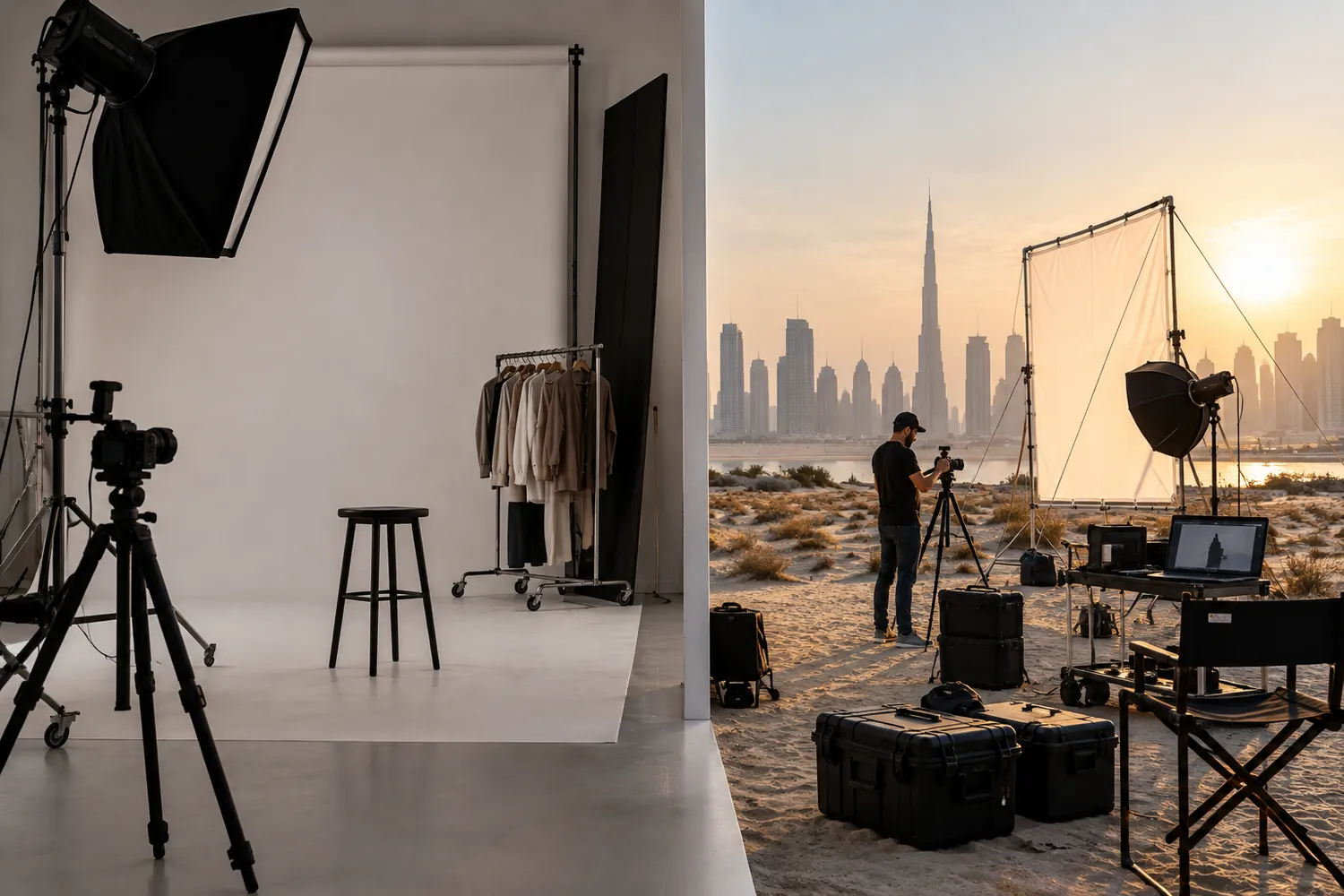
The choice between a studio and a real location gets made by habit more often than by reasoning — a business defaults to whichever one it used last time, without weighing what the specific shoot actually needs. Both options are genuinely right for different briefs, and both carry costs that only show up once the day is already booked.
What a studio actually buys you
A studio's value is control. Lighting is fully adjustable and repeatable, weather is irrelevant, there is no competing foot traffic or ambient noise, and a setup that isn't working can be rebuilt from scratch without losing the day. This matters most for product photography, where consistency across dozens of items depends on exact, repeatable conditions, and for any shoot with a tight schedule that cannot absorb an unpredictable variable. The cost is that a studio looks like a studio — a clean, neutral backdrop reads as exactly what it is, and no amount of styling fully substitutes for a real environment when the brief specifically needs one.
What a location actually buys you
A real location buys authenticity a studio cannot fabricate — the actual restaurant, the actual office, the actual street a brand operates on. For any story that depends on a genuine setting rather than a generic backdrop, this is not a stylistic preference, it is the point of the shoot. The cost is everything a studio removes: permits where required, the time and expense of scouting the space in advance, power access for lighting equipment, and a schedule now exposed to weather, foot traffic, and anyone else with a legitimate claim on the same space.
The hidden costs that decide the real comparison
A studio day rate usually already includes lighting infrastructure and a predictable, controlled cost — what it hides is the cost of building a convincing environment from scratch if the brief needs one, in props, set dressing and styling time. A location day rate looks cheaper on paper until permit fees, scouting time, equipment transport and a genuine weather contingency are added — costs a studio simply does not have. Comparing the two fairly means pricing what each option needs beyond the day rate, not just the day rate itself.
Questions that actually decide it
Does the story genuinely require a real, recognisable setting, or would a well-styled neutral background do the job just as well? Is the schedule tight enough that an uncontrollable variable like weather is a real risk rather than a manageable one? Does the shoot need repeatable, identical conditions across many items or many days, which only a studio guarantees? And is the location's authenticity worth the added coordination — permits, scouting, power, weather — or is it a nice-to-have that a studio backdrop could substitute for at a fraction of the planning cost?
Neither option is the safe default
Treating a studio as the automatically safer choice ignores that some briefs simply fail without a real setting, and treating a location as automatically more authentic ignores that a poorly scouted location with unreliable power or unpredictable weather can cost more in lost time than it ever gains in credibility. The right choice depends on what the specific shoot needs to prove, not on which option feels less risky by default.
Our production team scouts and prices both options honestly for every brief, so the decision is made on what the shoot actually needs rather than on habit.


