
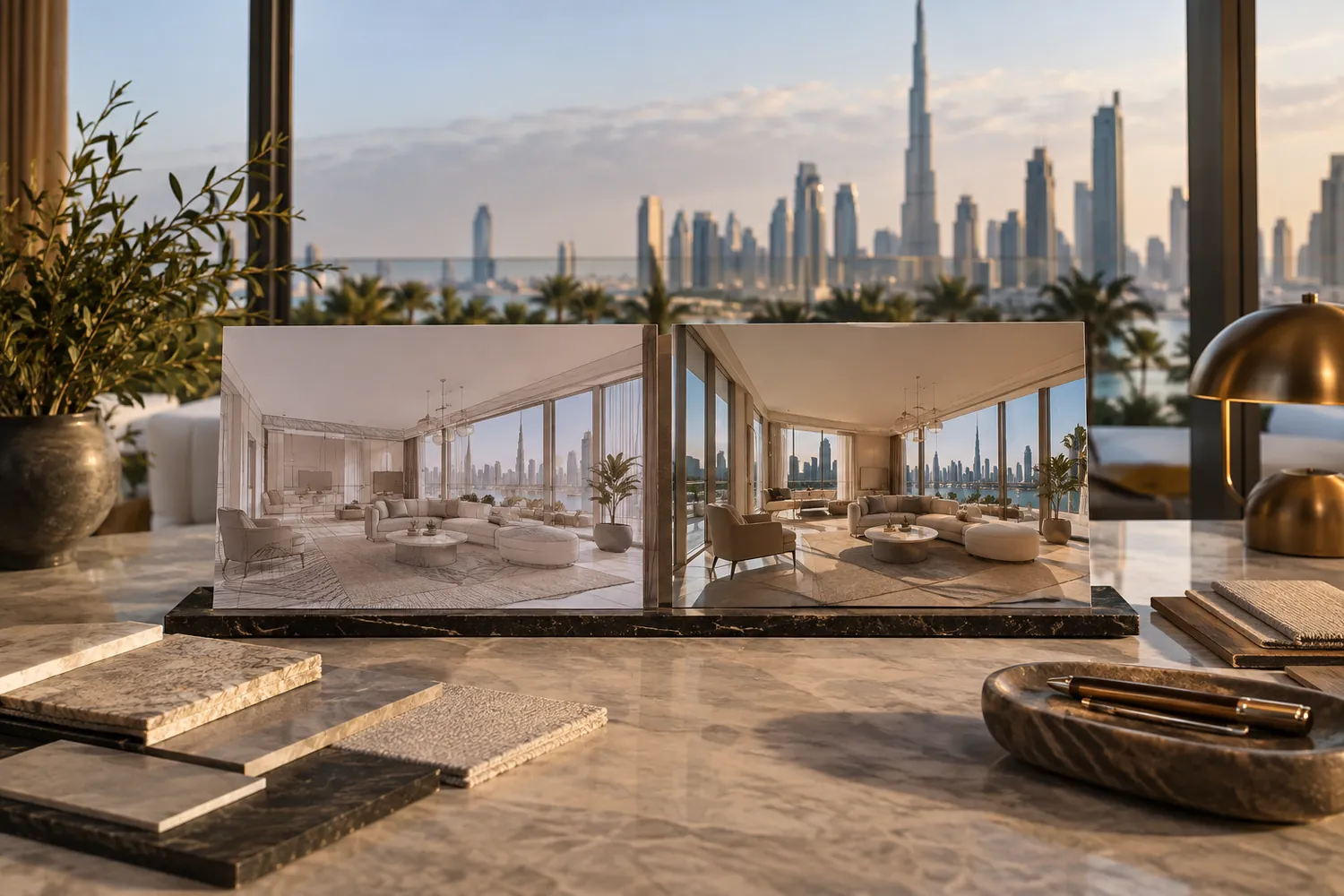
A render is doing a job no photograph can do: showing a building that does not exist yet. That job comes with a specific risk photography never carries — every element in a render is a choice, made by someone trying to sell a unit, and every choice that makes the image more appealing becomes an expectation the buyer will check the finished building against.
Every choice in a render is a small promise
Nobody instructs a visualisation studio to make a render look worse than the finished building will actually be. The natural pull of the process is toward the most flattering version of every decision — the most generous light, the most spacious-feeling furniture layout, the clearest possible view. None of this is dishonest on its own. It becomes a problem only when the render is treated as neutral information rather than as a set of choices that a buyer will hold the developer to.
Where renders tend to overstate
A handful of details cause most of the disappointment at handover, and they are worth naming rather than leaving implicit. Furniture in a render is almost always scaled to make rooms read as more spacious than they will feel once a buyer's actual furniture is in them. Landscaping is usually shown at a maturity the planting will not reach for years. Light is often rendered at the most flattering hour of the day, not the hour a buyer will actually be standing in the room. And a view is frequently shown as it exists today, with no visual acknowledgement that an adjacent plot not yet built on could change it entirely by handover.
None of these choices is unusual in the industry. What matters for expectation-setting is not avoiding them but not letting them go uncaptioned.
The moment the gap becomes a complaint
At handover, a buyer does the comparison whether or not the developer invites it — holding the render up against the finished unit, consciously or not. A reasonable gap between a labelled artist's impression and the finished product rarely generates a complaint on its own. An unlabelled gap does, because it reads as the difference between what was promised and what was delivered, even when the finished unit is genuinely good. The complaint is very often not about the quality of the building — it is about the credibility of everything the developer said before it existed.
Captioning the render honestly
The fix is specific rather than general: the render needs a caption that does more than say "artist's impression," because that phrase alone has stopped doing much work in a market where every render carries it. A materials board showing the actual finishes alongside the render, a note on the real planting timeline where landscaping is shown mature, and a floor plan with real dimensions next to a furnished render that implies more space than the unit has — these are the specific disclosures that close the gap before a buyer walks in imagining something the unit was never going to be. Where a view could plausibly change because of future construction on land the developer does not control, that is worth flagging directly rather than leaving it to be discovered at handover — and it is worth confirming the current listing-disclosure requirement with your broker's compliance team, since what has to be shown alongside a render is not something to guess at.
What the follow-up photography has to do
The discipline does not end when the building is finished. Our photography team treats handover photography as the second half of a promise the render made first — same vantage points where the render allows it, same honesty about what has and has not changed since the render was drawn. That continuity is what lets a buyer trust the next render this developer publishes, on the next project, which is the real cost of getting this one wrong. For how the render fits inside the rest of an off-plan campaign, the broader framework is worth reading alongside this.


