
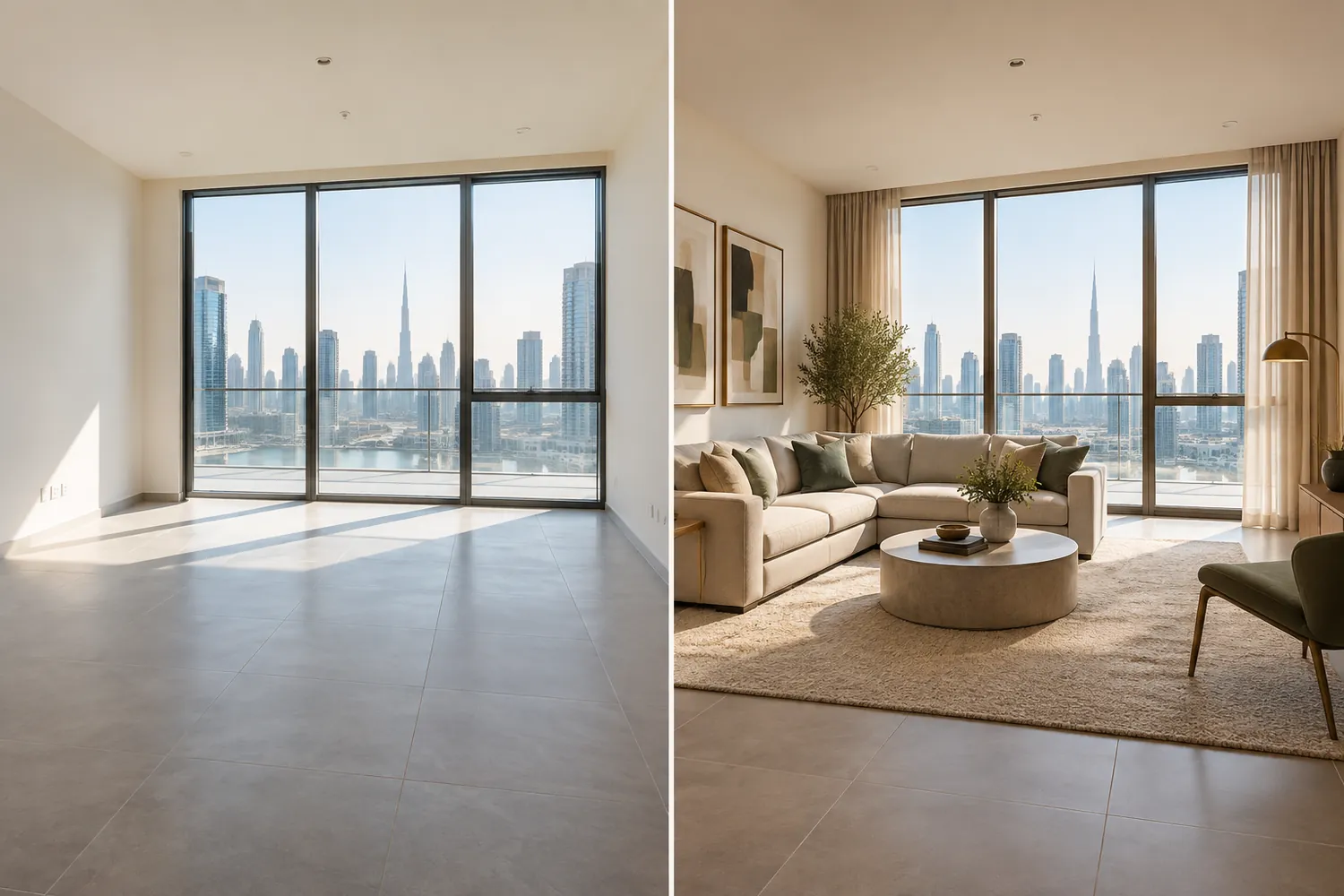
An empty room photographs badly for a reason that has nothing to do with the room itself: most buyers cannot picture scale or function from bare walls and a floor. A living room with no furniture reads as smaller and colder than the same room with a sofa and a rug in it, even though nothing about the actual space has changed. Virtual staging — digitally placing furniture into photos of a real, existing empty room — exists to close that gap in imagination, and used well, it does exactly that and nothing more.
What it is genuinely useful for
A vacant unit is the clearest case: no furniture to work around, no tenant's belongings to remove from frame, just a real empty room that needs help conveying what it would look like in use. Digitally furnishing that room lets a buyer judge whether their own furniture would fit, whether the space reads as a one-seating-area room or a room that could hold a dining table too, without the seller paying for physical staging furniture that has to be delivered, arranged and later removed. This is showing potential, clearly rooted in a real, current, physically existing room.
Where it turns into misrepresentation
The line is not the technique, it is the disclosure. A digitally staged image that isn't labelled as such is not showing potential anymore, it is presenting an edited image as if it were a photograph of the property as it currently sits — and a buyer who arrives to find a bare room where the listing showed a furnished one has grounds to feel misled, whether or not that was the intent. The same applies to any digital edit that changes what the room structurally is, not just how it is furnished: virtually adding a feature the unit doesn't have crosses from staging into misrepresentation regardless of labelling, because no disclosure fixes a claim about the physical unit that isn't true.
Labelling that actually works
"Virtually staged" printed once in a photo caption that nobody reads past the thumbnail is not meaningful disclosure. A clear label directly on the image itself, visible at thumbnail size, tells a buyer immediately what they are looking at without requiring them to hunt for a disclaimer — and it protects the agent as much as the buyer, because a buyer who understood the image before booking a viewing arrives with accurate expectations rather than a grievance.
Confirm the specific requirement before publishing
What exactly has to be disclosed about a digitally staged image, and how, is the kind of listing-disclosure requirement that varies and changes — confirm the current standard with your broker's compliance team before a staged image goes live, rather than assuming the labelling convention used on the last listing is still the correct one.
The scope worth being precise about
This is specifically about furnishing a room that exists today, empty, as it is — not about rendering a building that hasn't been completed yet, which involves a different set of expectations and a different set of disclosure questions entirely. Confirm the current listing-disclosure requirement with your broker's compliance team either way, since the rules a business relies on here are not something to assume from memory.
Why the honest version still converts
A clearly labelled staged image does the same imaginative work as an unlabelled one — it just does it without the risk of an angry viewing appointment and a buyer who no longer trusts the agency's other listings, which matters for the referral relationships an agent's reputation depends on well beyond any single sale. Our photography team treats virtual staging as a genuine tool for showing potential in an existing empty room, labelled honestly, not a way to make a listing look like something it currently is not.


