
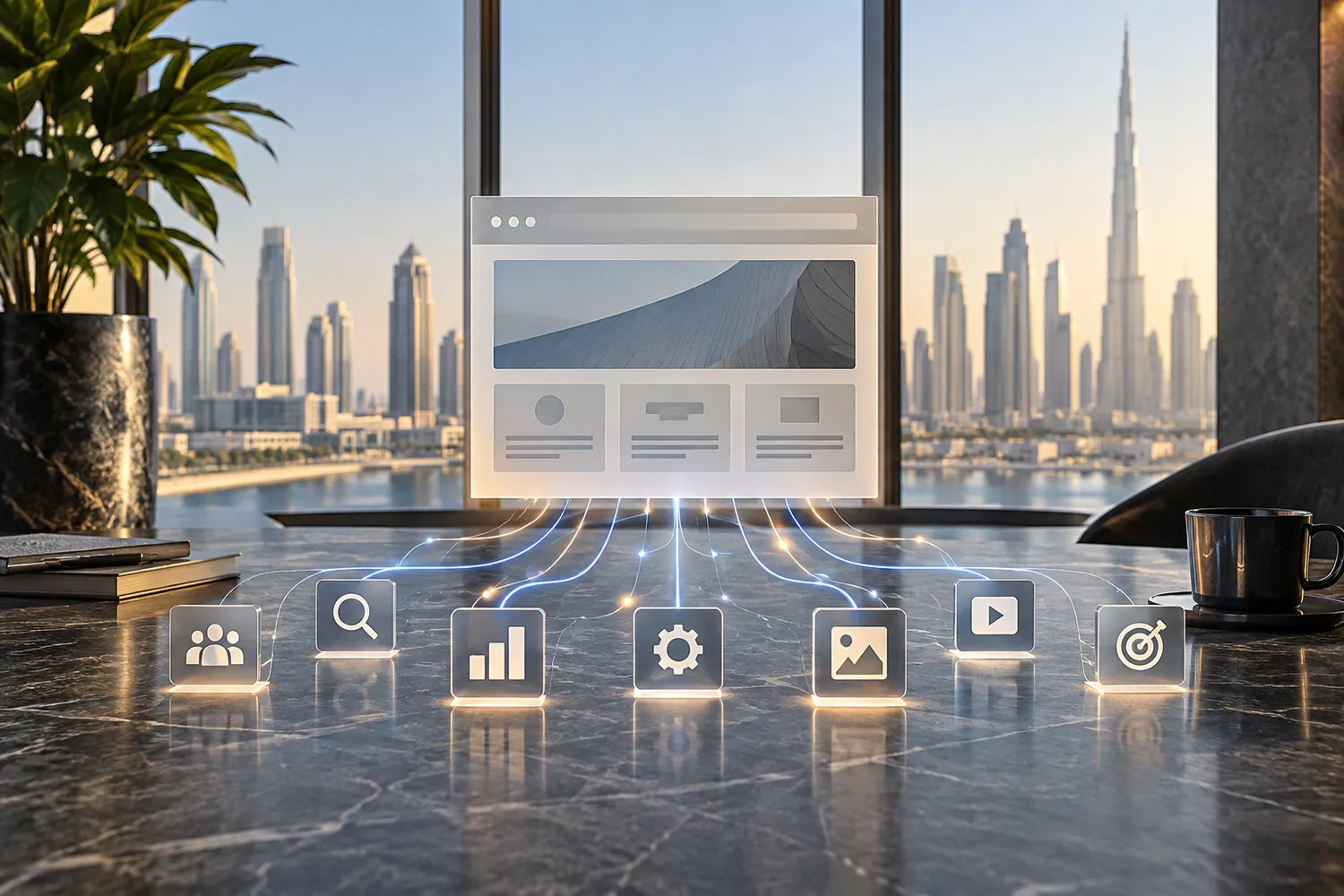
Ask most business owners what their website needs to do and the answer is some version of "look professional." That is not a wrong answer, but it is an incomplete one, and the gap between "looks professional" and "functions as a business system" is where most sites quietly underperform for years without anyone quite noticing why.
A brochure is a static object. It is finished when it looks right and gets reprinted only when something changes. A business system is closer to a piece of infrastructure — plumbing, not decoration — and it is judged on what it does under real conditions: does it capture the enquiry, answer the question that would otherwise become a phone call, and stay up and fast when someone actually needs it.
What "does the work" actually means
It captures enquiries at the moment of intent. A visitor who is ready to act should never have to hunt for how. A contact form buried three clicks deep, a phone number in a footer nobody scrolls to, a "get in touch" that leads to a generic page instead of the specific next step for what they were just looking at — each of these quietly loses a person who was ready to convert right then and will not necessarily come back to try again.
It answers the questions that would otherwise become a support call. Every business has a short list of questions that come up constantly — pricing structure, how a process works, what is included. A site that answers these clearly, on the page where someone is already asking the underlying question, prevents a phone call or an email that a team then has to handle manually. A site that doesn't generates that same volume of manual work indefinitely, and nobody ever traces the cost back to the missing paragraph on a service page.
It carries the load without falling over. A brochure does not need to survive a traffic spike; a business system does, because the spike is often the exact moment — a press mention, a campaign that worked, a referral that went viral in a WhatsApp group — when the business most needs the site to hold up. A slow or unreliable site at that moment does not just lose the visit; it can make a real, unrepeatable opportunity look unprofessional at the worst possible time.
Where the brochure mindset shows up
It shows up in what gets prioritised during a build. A brochure-minded project spends its review cycles on font choices and hero imagery and treats the contact form, the loading speed and the mobile experience as afterthoughts to be handled once the "real" design is approved. A system-minded project treats those as the actual deliverable and the visual design as the layer that has to work around them, not the other way round.
It also shows up after launch. A brochure is left alone once it is published — there is nothing to check, because nothing was meant to keep working over time. A business system needs the same ongoing attention any infrastructure does: does the form still deliver, does the site still load quickly as content grows, do the pages that used to answer a question still answer it after the business's offering changed.
What changes when a site is built this way
The practical difference shows up in the brief before a single page is designed. Instead of starting with "what should it look like," a systems-first build starts with a short, specific list: what should someone be able to do here that they cannot do today, what question currently generates a phone call that a page could answer instead, what happens on a page when the connection is slow or the visitor is on a five-year-old phone.
None of this argues against a site looking good — a site that looks unprofessional will lose trust regardless of how well it functions underneath. The argument is about what gets decided first and what the whole project is ultimately judged against. A beautiful site that loses enquiries at the contact form is a worse business outcome than a plainer one that reliably captures them, even though the first would win almost every design review.
A site built and evaluated as a system needs the same discipline in what gets measured after launch as it does in what gets built before it: enquiries captured, questions answered without a follow-up call, load times under real conditions rather than a lab test. Our web team builds and evaluates every site against that standard, because a site that only has to look good in a screenshot was never actually finished.


