
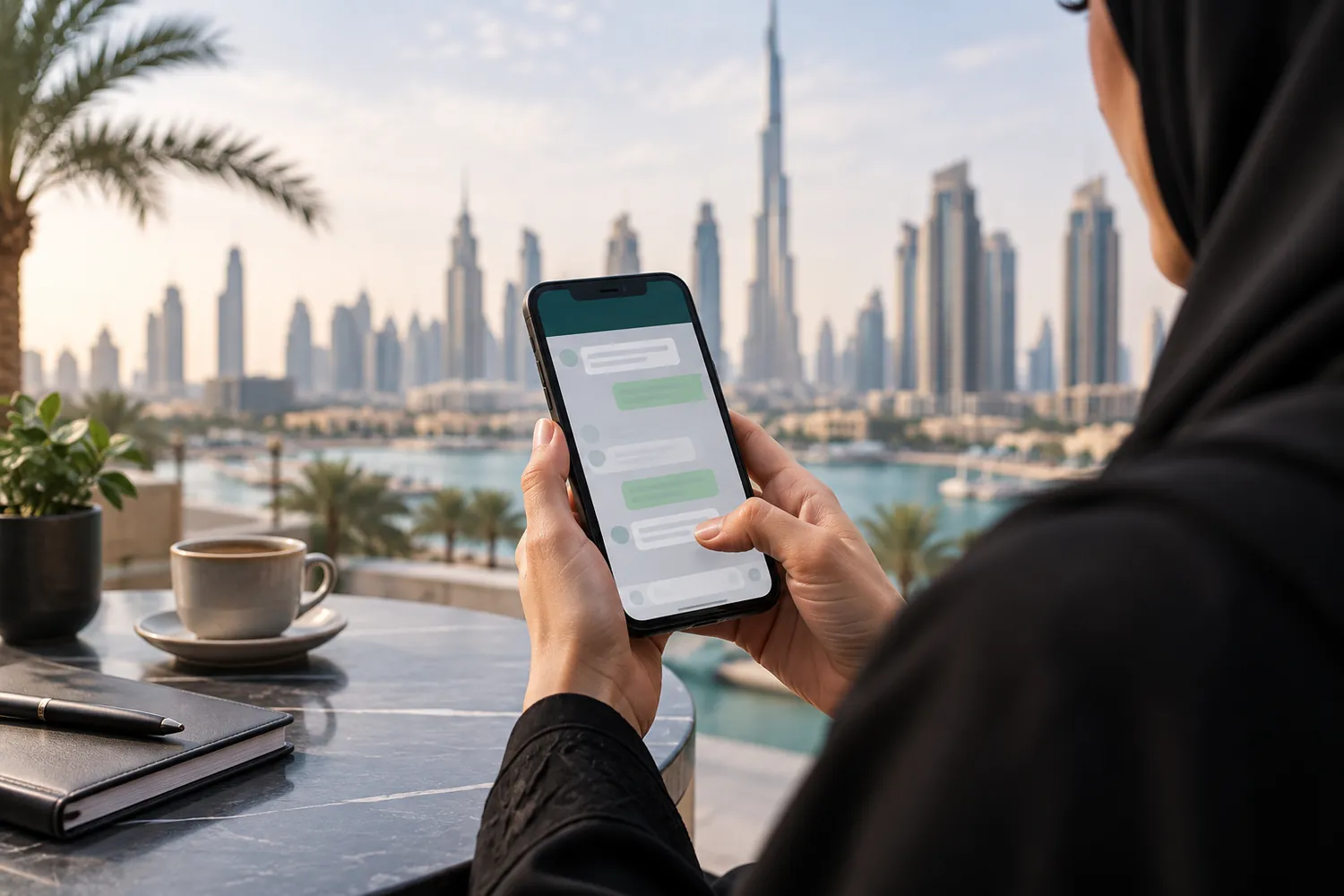
In a lot of Western markets, WhatsApp is treated as a personal messaging app with business use bolted on. In the UAE and across the wider Gulf, the relationship is closer to reversed: it is often the primary channel a customer expects to use with a business at all, ahead of email and sometimes ahead of a phone call. A clinic confirming an appointment, a retailer sending a delivery update, a contractor sharing a quote with photos attached — all of it routinely happens over WhatsApp here in a way that would feel unusual in a market where email still owns that role.
Why the channel carries this weight locally
Part of it is simply usage: WhatsApp penetration in the region is very high, and it is already the default way people communicate with friends, family and colleagues, so a business message arriving there does not feel like a shift in context the way an unfamiliar app or a formal email does. Part of it is practical — a resident population that includes a large share of people managing life in a second or third language often finds a short WhatsApp message, sometimes with a voice note attached, easier to process quickly than a longer, more formal email. And part of it is simply habit built up over years of businesses meeting customers where they already were rather than trying to move them somewhere else.
What this changes about how a business should use it
Because WhatsApp sits inside the same app where someone talks to their family, the tolerance for anything that reads as broadcast marketing is lower than on a channel a customer opened specifically expecting promotional content. A message that would be an unremarkable marketing email — a generic seasonal offer sent to an entire list — reads as an intrusion in the same thread where a customer's sister just sent a photo. The businesses that get real value from WhatsApp treat it closer to how they would treat a phone line: used for things a specific customer actually asked about or opted into, not a list to be blasted on a schedule.
Where WhatsApp Business tools actually help
The WhatsApp Business platform gives a business genuine structure — catalogs customers can browse, quick replies for common questions, labels to track where a conversation sits, and a business API for handling volume once a single phone cannot keep up. Used well, these close gaps that made the channel feel chaotic at small scale: a catalog answers the price question before it has to be typed out again for the fifth time that day, and labels stop a follow-up from being missed in a thread that moved on to something else. Used badly, the same tools make it easy to schedule broadcast messages to an entire contact list, which is exactly the behavior that erodes the trust the channel depends on.
Running it without becoming spam
The distinction that holds up is opt-in versus assumed permission. A customer who messaged first, or who explicitly agreed to updates about an order or appointment, is a legitimate recipient for follow-up on that specific thing. A customer whose number was collected for one purpose and then added to a general marketing list was not asked, and the eventual unsubscribe — often a block, which is more final than unsubscribing from email — costs more goodwill than the message was worth. This same discipline about permission and channel fit runs through our SEO strategy for specific businesses, which treats channel choice as something earned by matching actual customer behavior, not assumed from a platform's popularity.
If WhatsApp is already carrying real conversation volume for your business but nobody has set up the structure to manage it well, our marketing team can help build the catalog, response workflow and permission rules that keep it a channel customers want to keep using.


