
A voice guide built entirely from adjectives — bold, warm, approachable, innovative — reads perfectly reasonable in a workshop and turns out to be almost useless the first time someone actually tries to write a caption from it, because adjectives describe an impression, not a set of decisions a writer can actually make. The gap between "sounds warm" and knowing whether this specific sentence should end with a period or an exclamation point is exactly where most brand voice guides fail.
Why invented adjectives do not transfer
An adjective on a mood board is a target, not an instruction. Two different writers asked to sound "bold" will make genuinely different choices about sentence length, directness, humour and formality, because "bold" was never actually derived from how the business communicates — it was chosen because it sounded good in a workshop. A voice that was invented rather than observed has no anchor in anything real, which is why it drifts the moment more than one person is writing for the brand.
Start from what already worked
The more reliable approach is to derive voice from things the business has already said well — a proposal that closed a deal, a support reply that visibly de-escalated an angry customer, a social post that got an unusually strong response, an email a founder wrote in five minutes that somehow landed better than the polished version a committee produced. These are not hypothetical; they are evidence of a voice the business already has, whether or not anyone has written it down.
Turning examples into rules
Collect ten to twenty of these real examples and look for what they actually share: sentence length, how directly they get to the point, whether and how they use humour, how formal or informal the vocabulary runs, how they handle bad news or disagreement. Name these traits using concrete, checkable markers rather than vague adjectives — not "friendly" but "uses the customer's name, keeps sentences under twenty words, never opens with an apology unless one is actually owed." A rule stated this specifically can actually be checked against a draft; an adjective cannot.
Do and don't, from real rewrites
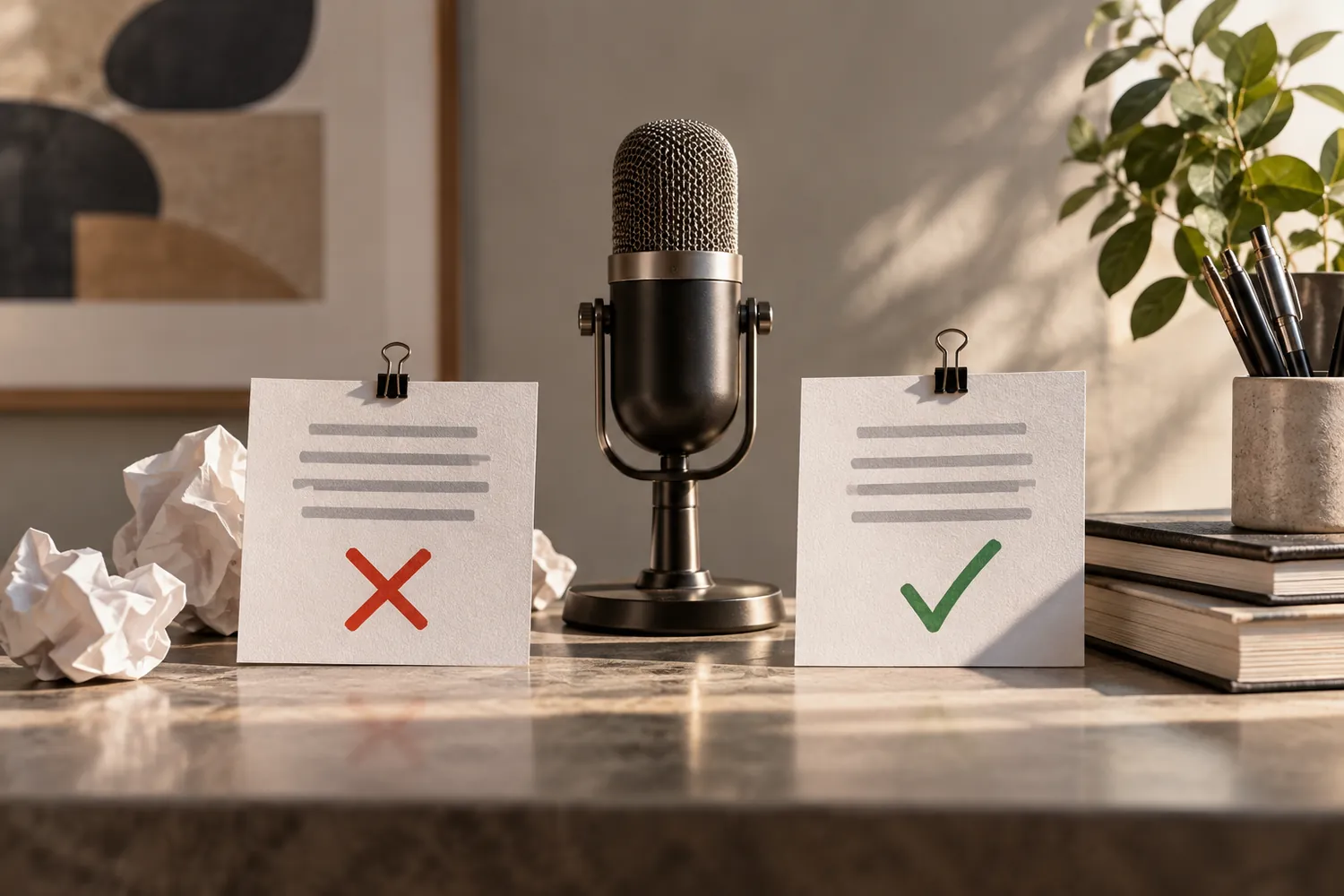
The fastest way to teach a voice is a real sentence the brand wrote well, paired with a rewritten version showing what the same message would sound like off-voice — too formal, too casual, too evasive, whatever the actual failure mode tends to be for this specific business. A handful of real before-and-after pairs teaches a new writer faster than several paragraphs of abstract description, because it shows the actual decision being made rather than describing the impression the decision is meant to create.
Where this most often goes wrong
The common failure is a voice guide built from the adjectives a leadership team wishes described the brand, rather than the traits actually present in the business's own best communication. A wished-for voice produces guidance nobody can consistently apply, because it does not match how anyone at the business actually writes when they are writing well — which means every new hire has to be corrected against an invisible standard rather than shown a real, working example.
What a derived voice buys a brand
A voice guide built from real, working examples gives every new writer — a hire, an agency, a founder delegating for the first time — something they can actually check their draft against, not an impression they have to guess at. Our branding team starts every voice project by collecting the business's own best writing before proposing a single adjective, because the strongest voice guide is usually a description of something the business was already doing well.


