
Adding a livestream to an in-person event feels like an obvious way to grow the audience — anyone who cannot attend in person can still watch. What often goes unexamined is the other direction: a livestream can also talk someone who could have attended in person out of making the trip, if watching from home looks close enough to being there. A hybrid event that quietly cannibalises its own room has not grown its audience, it has just moved part of it somewhere the organiser has less control over.
Why a good stream can shrink the room
A local attendee weighing whether to book time off, sit in traffic and travel across the city will notice if the stream promises the same keynote, the same slides and the same Q&A without any of the friction. If the online version looks like a complete substitute rather than a lesser one, the rational choice for a borderline attendee is to stay home — and an event loses exactly the in-person energy, networking and floor traffic that made hosting it in person worthwhile in the first place. This is not a reason to avoid streaming; it is a reason to design what each audience actually gets.
Giving the room something the stream cannot offer
The fix is not to make the stream worse, it is to make the in-person experience distinct rather than merely the same content with extra travel attached. Networking time, hallway conversations, hands-on demonstrations, small-group sessions that are not filmed, and the informal access to speakers that only happens in person are not things a stream can replicate at any quality level. Naming these explicitly in the event's own promotion, rather than assuming attendees already know the room offers more, gives a genuine, specific reason to travel in rather than relying on vague appeals to the atmosphere.
Designing the stream as its own experience, not a leftover feed
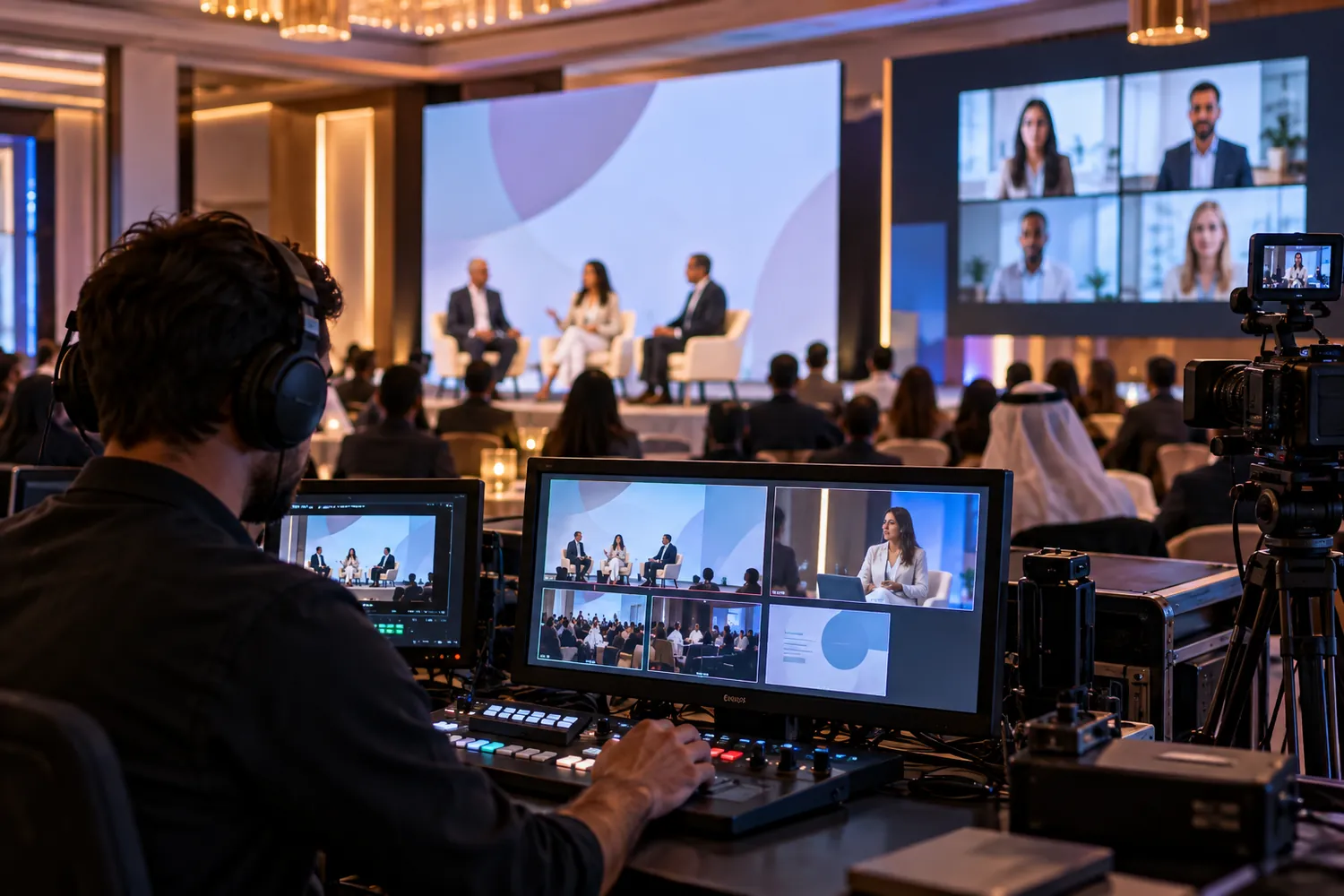
A camera pointed at a stage from the back of the room produces a stream nobody enjoys watching for more than a few minutes, which undersells the online option as much as an overly complete stream oversells it. A stream built deliberately — multiple camera angles, clean audio, a moderated chat with someone actually reading it, timed breaks that match how long a person can watch a screen rather than how long a room can sit through a session — gives the remote audience a good experience without needing to duplicate the in-person one entirely. The two audiences do not need identical content to both feel well served. This distinction is made in the stream production itself, and it needs to be planned before the event, not assembled from whatever camera happens to be pointed at the stage.
Pricing and access as part of the design
How the stream is priced and positioned also shapes attendance behaviour. A free stream running alongside a paid in-person ticket removes the online audience's only reason to consider travelling in, while a stream priced or scheduled slightly differently — a delayed release, a shorter highlights cut rather than the full raw feed, a lower tier of access than the in-person ticket — keeps the two audiences distinct rather than directly competing for the same person's attention. The goal is not to make the stream worse for its own sake, but to make the choice between the two genuinely a choice between two different things.
Treating hybrid as two designed experiences, not one plus a camera
The organisers who grow attendance with a hybrid format are the ones who plan the in-person and online experiences as two distinct products from the start, rather than building the room and then figuring out what to point a camera at. That planning has to happen early enough to shape the run sheet itself — which sessions are streamed, which are kept in-room only, and how each is produced for its own audience.
Done well, streaming becomes a genuine extension of the audience-building work that fills the room rather than a quiet substitute for it. Our photography and video team plans stream production as its own deliverable, built to make the online audience feel well served without ever making the in-person ticket feel like the wrong choice.


