
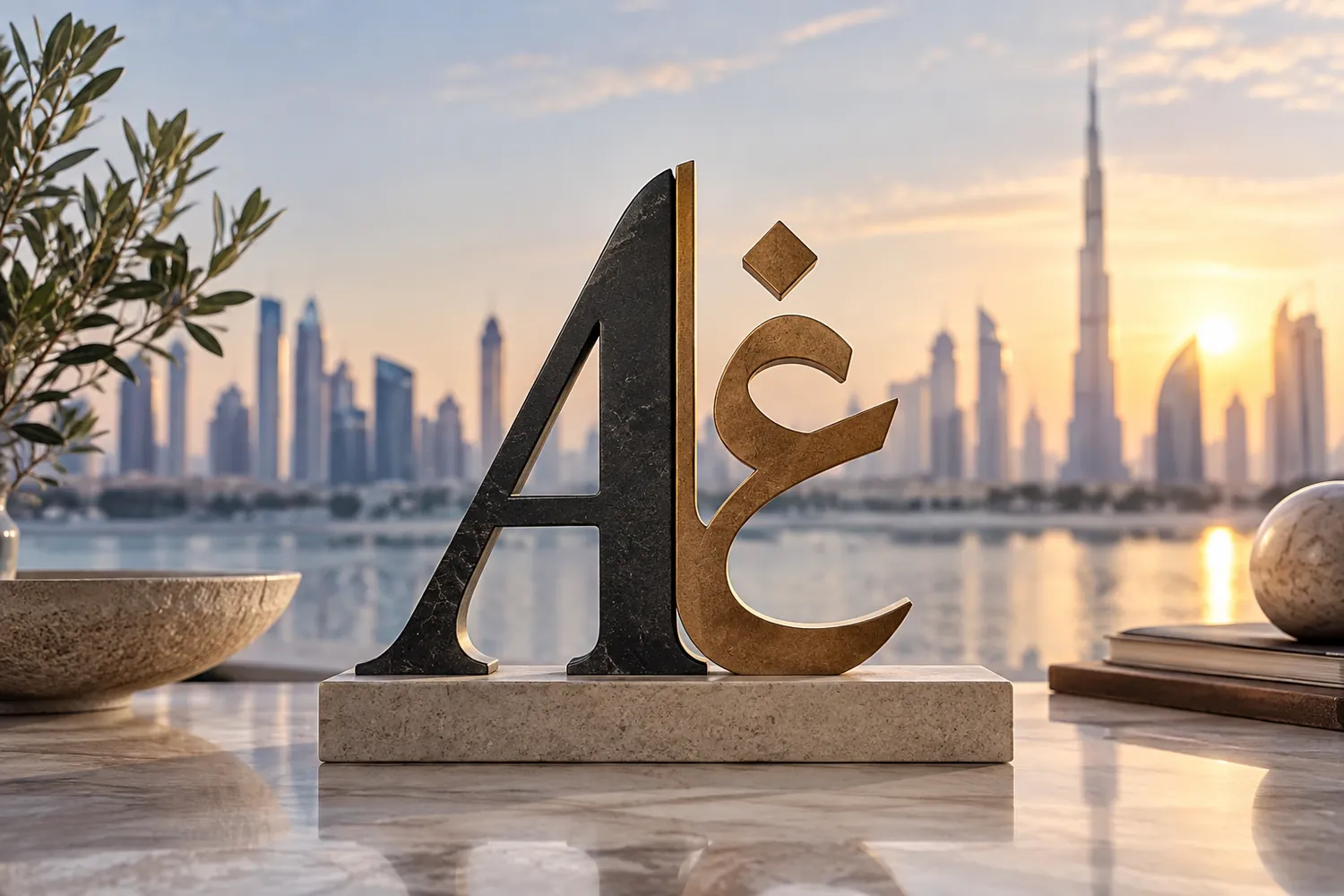
A name that tests beautifully in English and gets approved before anyone has said it out loud in Arabic, or the reverse, is one of the most common and most avoidable mistakes a UAE business makes at the naming stage. The two scripts do not fail in the same way or at the same point, which is exactly why a name has to be tested in both, deliberately, before it is chosen rather than after.
Pronunciation across two sound systems
Arabic and English do not share the same set of sounds, and a name built around a sound that does not exist cleanly in the other language will get mispronounced consistently, not occasionally. A name that leans on a vowel sound or consonant cluster comfortable in English can be genuinely awkward to say in Arabic, and the reverse holds just as often — certain Arabic sounds have no true English equivalent and get flattened into something else entirely when English speakers attempt them. The test is not whether a name can technically be said in both languages; it is whether a first-time speaker in either language says it correctly without being taught how.
Transliteration has to be decided once, not improvised
An English name written in Arabic script, or an Arabic name written in Latin script, needs one settled, canonical spelling — not three different versions floating around because different staff members, printers and signage vendors each transliterated it their own way. Inconsistent transliteration quietly undermines the very recognition a name is supposed to build, because a customer searching for the business by the spelling they remember may not find the spelling actually in use. Settling this once, in writing, before the name reaches a sign-maker or a business card, avoids a slow-motion identity problem nobody notices until it has already spread.
Meaning has to be checked in both directions
A word or combination that reads as clever, modern or pleasant in one language can carry an entirely unintended meaning, or simply mean nothing at all, in the other. This is not a rare edge case — it is a routine risk any time a name is chosen primarily for how it sounds in one language without a native speaker of the other checking it for connotation, double meaning or accidental resemblance to an unrelated word. This check should happen with an actual native speaker of each language, not a translation tool, because tone and connotation are exactly what automated translation misses.
Domain and handle availability, across both
A name can be genuinely available and legally clear and still be unusable online if the matching domain and the social handles a business actually needs are already taken in one script but not the other — a common outcome when a name works well enough in English to have already been claimed by someone unrelated, while the Arabic transliteration remains open, or vice versa. Checking availability across both scripts before falling in love with a shortlist candidate saves a second, more painful naming round later.
A working process
Shortlist candidates that pass a first pronunciation check in both languages before doing anything else with them. Settle one canonical transliteration in writing for each finalist. Have a native speaker of each language independently check meaning and connotation, without being told what the name is supposed to evoke, so their honest first reaction is worth something. Check domain and handle availability in both scripts before the final decision, not after. Our branding team runs bilingual naming through all four checks before a name is ever put in front of a sign-maker, because a name that fails quietly in one language is a cost paid for years, not once.


