
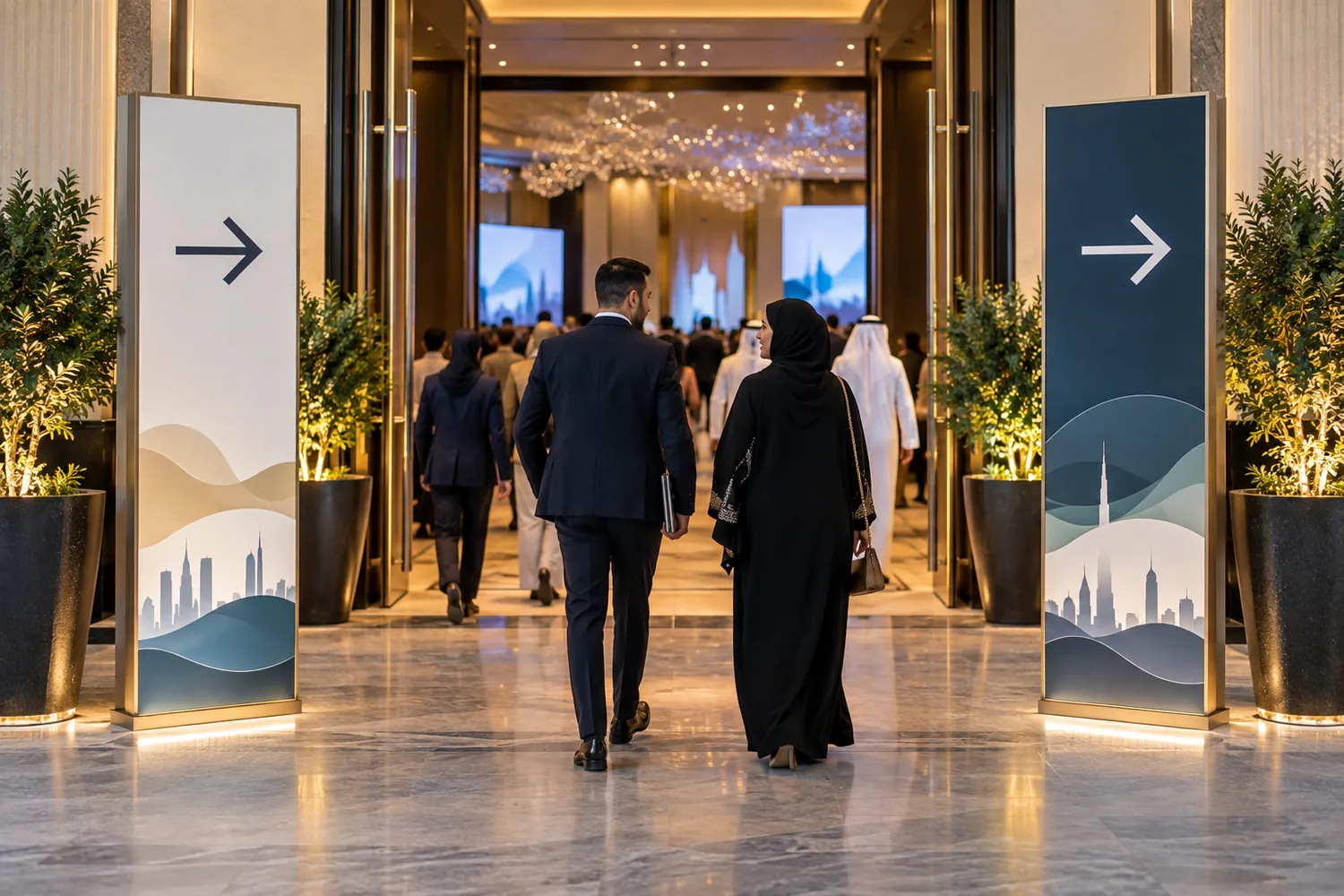
An event in the UAE that treats Arabic as an afterthought — a signage template translated the week before, a run of show written only in English with an interpreter improvising alongside it — is usually noticeable to a meaningful share of the room, and it reads as a choice rather than an oversight. Running a genuinely bilingual event is not a matter of translating a finished English event into Arabic at the end; it has to be planned as bilingual from the layout stage onward.
Signage that works in both directions
Arabic reads right to left and English reads left to right, and signage designed for one and adapted for the other tends to look adapted rather than designed. Wayfinding, directional arrows, agenda boards and stage backdrops need a layout that genuinely accommodates both reading directions rather than mirroring an English template and hoping the Arabic text fits the leftover space. This is a design decision, not a translation task, and it has to be made before the English version is finalised, not after.
Interpretation versus pre-translated materials
Not every bilingual event needs simultaneous interpretation, and not every one can skip it. A panel discussion or a keynote with genuine back-and-forth usually needs live interpretation — booth, headsets, a qualified interpreter briefed on the subject matter in advance — because pre-translated slides cannot capture unscripted conversation. A structured presentation with fixed content, by contrast, can often be handled with dual-language slides and printed materials, which cost less and avoid the technical setup interpretation requires. Deciding which sessions actually need live interpretation, rather than defaulting to either extreme, is a real planning decision with a real budget attached.
Writing the run of show for two languages
A run of show timed for English-only delivery runs short the moment interpretation is added, because consecutive interpretation roughly doubles the time a segment takes and simultaneous interpretation still needs padding around transitions and audience questions. An MC script written for one language and then read aloud in translation on the day, without ever being timed that way in rehearsal, is one of the most common causes of an event running badly over. The fix is building the padding into the schedule from the start and briefing every speaker on how their segment will actually run, not just how long their slides are.
What genuinely needs duplication, and what does not
Full bilingual duplication is expensive, and not every asset needs it. Registration forms, safety information and anything a guest needs to act on independently should exist properly in both languages, not as a rough translation bolted onto the English original. Badge design, stage backdrops and headline signage carry brand weight and are worth doing properly in both languages as well. Deeper materials — a detailed speaker bio sheet, a background document only a handful of attendees will read closely — can sometimes stay in a single language without meaningfully hurting the event, as long as that choice is deliberate rather than a shortcut taken under deadline pressure.
Our marketing team plans bilingual events as bilingual from the first layout draft, not as a translation pass applied at the end, because the difference is visible to exactly the audience an event in this region is trying to reach. Getting this right matters well before the room fills — it sits alongside the wider work of filling an event as one of the details that decides whether the audience feels genuinely considered or merely accommodated.


